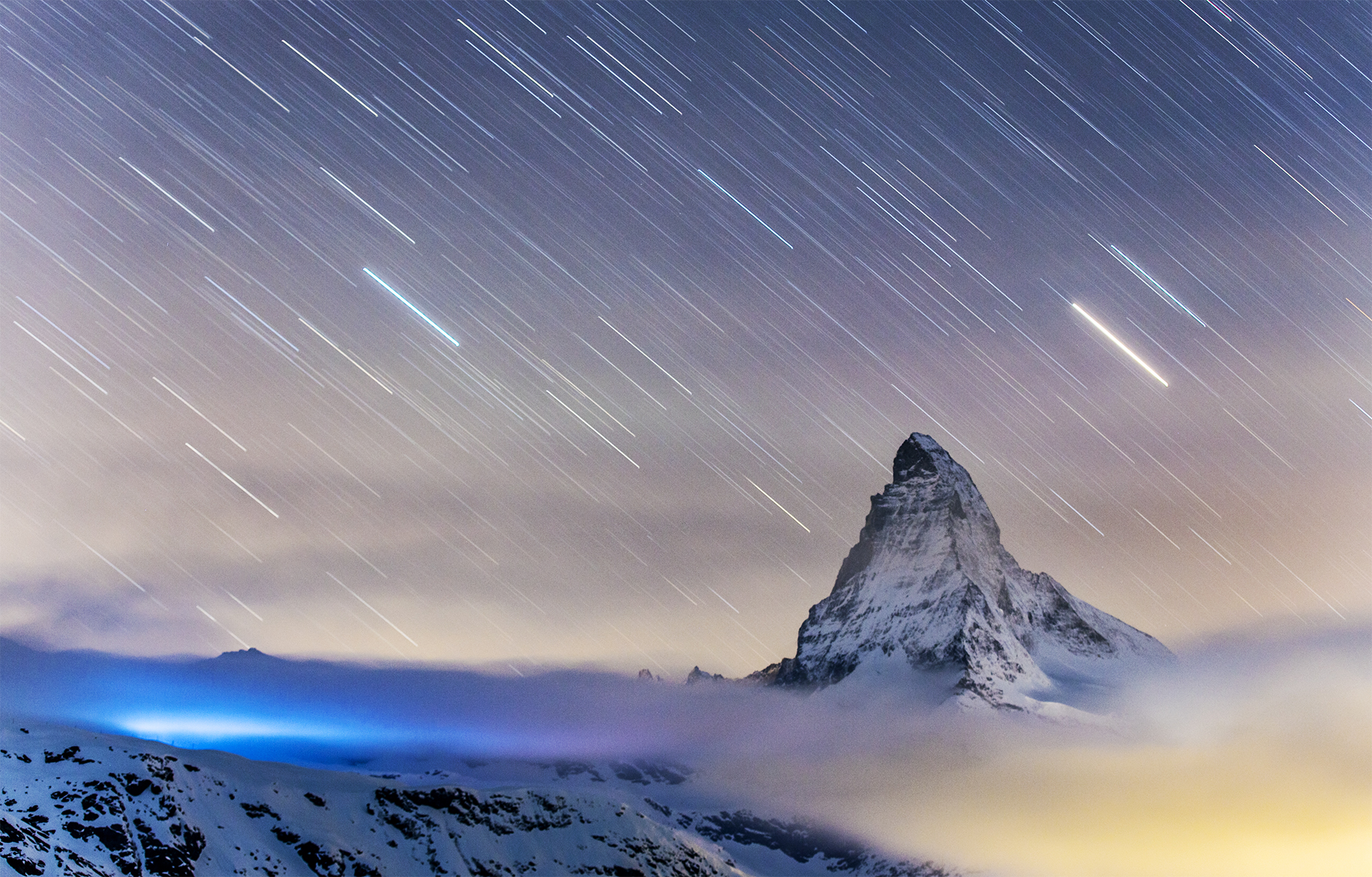
I've been traveling a lot lately to Switzerland, twice getting really close to the Matterhorn after our dear star was hidden from sight by the edge of the Earth. Enjoying the cold, I took a few pictures, out of which I like this one best.
Tuesday, May 6, 2014
Matterhorn at night
Labels:
Alps,
astronomy,
Matterhorn,
night,
star,
Switzerland,
trails
Location:
Zermatt, Switzerland
Polaring ring galaxies at their best: NGC 660
NGC 660 is a polar ring galaxy, found about 20 million light years away towards the constellation of Pisces. Polar ring galaxies are named as such as a substantial proportion of the stellar population, gas and dust orbit the galaxy in rings. These rings are thought to be created by interaction with a neighbouring galaxy.
This image was obtained in late September 2013 as part of the first light tests for the new Prime Focus Imaging Platform (PFIP) mounted on the 4.2m William Herschel Telescope. The false color image is composed of a total of ~40 minutes of Johnson-Bessel BVR data.
Labels:
CCD,
first light,
galaxy,
IAC,
imaging,
La Palma,
NGC 660,
observatorio del roque de los muchachos,
ORM,
PFIP,
polar,
prime focus,
ring,
telescope,
WHT,
William Herschel Telescope
Location:
Roque de los Muchachos, La Palma, Spain
Tuesday, January 28, 2014
SN 2014J
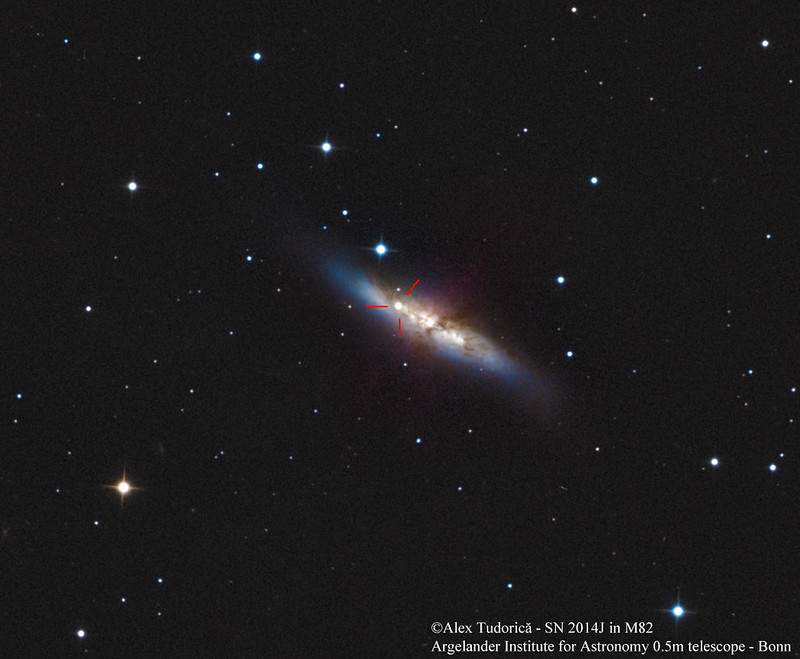
Supernova in M82: SN 2014J It's a quite important supernova, as it could shed light on some issues that these cosmic standard candles have. Too bad it has a lot of dust reddening, which complicates matters a lot.
Having a look a the AAVSO light curves, I'd say that it won't be brighter than 9.5m at maximum, but let's see!
Here's the image taken with our 0.5m rooftop telescope in Bonn, at the Argelander Institute for Astronomy:
Having a look a the AAVSO light curves, I'd say that it won't be brighter than 9.5m at maximum, but let's see!
Here's the image taken with our 0.5m rooftop telescope in Bonn, at the Argelander Institute for Astronomy:
Technical details here: http://www.flickr.com/photos/27891676@N05/12165418933/
Location:
Bonn, Germany
Thursday, October 24, 2013
Startrails in the Canaries
A few months ago I decided to look through my images from the Canary islands that I took during the past couple of years and make a few star trails out of them. Below are the selected four:
The western view from the INT 2.5m telescope terrace. Moon, Venus and Jupiter are the three brightest streaks in the image. An observer's car illuminates the road in red.
Mount Teide reigns in the left part of the image, while Venus and Jupiter set in the early twilight. For the cities below, the night has already arrived and the street lights illuminate the clouds from below.
Back to the island of La Palma, the MAGIC telescopes scan the skies for Cherenkov light cones, while the Moon high in the sky illuminates the landscape.
The final set of trails comes from near the top of the Teide Volcano in Tenerife. I love how the road is visible due to the (very few) passing cars and how a little bolide (at least -5m!) decided to show up near the lower right of the image.
Labels:
astronomy,
Canaries,
Canary,
islands,
jupiter,
moon,
ORM,
rotation,
startrails,
Teide,
twilight,
venus,
volcano
Location:
Canary Islands, Spain
Airplane Optics
Flights and tall buildings or mountains are some of the best ways to see a different class of atmospheric optical phenomena, namely those which lie opposite to the sun. In the images below, diffraction in the cloud droplets produces a multi-ringed glory that surrounds the shadow of the airplane.
With the clouds slightly farther away, the shadow of the airplane gets smaller in respect to the size of the glory, which remains roughly constant.
Sometimes, when one can see a glory, the conditions are right also for producing a cloudbow (a type of fogbow) farther away from the airplane's shadow. A few supernumerary arcs are also visible in the image, on the inside of the main cloudbow arc.
Some similar images of mine were published as the Optics Picture of the Day some time ago.
Labels:
airplane,
arcs,
atmospheric,
cloudbow,
fogbow,
glory,
optics,
parry arc,
supernumerary
Location:
Europe
Antisolar halos
Although I'm a quite avid atmospheric optics observer, I rarely have to look down to see such phenomena. However, on a flight I took not too long ago, I was fortunate enough to see a few rare halos.
The interesting thing is that the subhorizon halos are like a reflection of the those above the horizon, and the very cool thing about it is that this reflection actually takes place inside the ice crystals that create these optical phenomena in the first place (on a lower horizontal plate). However, the sub- and over-horizon halos are not perfect reflections of each other.
The image below shows the antisolar point (bright spot in the lower right of the image), a portion of the subparhelic circle going horizontally through the antisolar point and the parry antisolar arcs, seen as two lines going through the antisolar point at an angle of about 60 degrees from the horizontal.
Les Cowley's excellent website does a much better job at explaining this stuff.
I'm just very happy that I saw them:
Location:
Europe
Tuesday, October 22, 2013
The Tadpole galaxy
In most of my fields for the PhD project I'm currently most involved in, there are lots of weird and interesting objects, most of them probably unknown, at least to the general public. However, from time to time I stumble upon gems such as the 400 million light years distant Tadpole galaxy:
Check out a high quality version on my Flickr account.
Location:
Hawaii, USA
Tuesday, September 10, 2013
M33 revisited
About one year ago we discovered that our 0.5m Cassegrain rooftop telescope can be used in prime focus mode, but until now I had little time to revisit a wonderful galaxy, M33.
There are many star forming regions visible in the Hydrogen alpha image (red in the image below), king of all being NGC 604, a nebula far larger than our familiar Orion Nebula.
Prime focus, 4 nights of imaging, RVBHa, about 2.5h per filter.
And the old, Cassegrain focus version, about 12h of exposure time in total, LRVBHa:
Location:
Bonn, Germany
Comet ISON (IV)
Comet ISON (C/2012 S1) is back, but not with a bang. It looks like the comet could not keep up the brightening rate and now the predictions for the maximum luminosity have dropped quite a lot (check out Seiichi Yoshida's awesome graphs and information about comet ISON). It can still surprise us, especially as it will pass so close to the Sun, but for the moment the hopes are not that high any more.
The comet was still in twilight when I photographed it for the first time after passing through the conjunction with the Sun. Images taken on the 3rd and 5th of September.
Image taken with the 50 cm telescope on top of the Argelander Institute for Astronomy.
Location:
Bonn, Germany
SN 2013EV
A very faint supernova in a galaxy that we've all seen so many times: IC 1296. Not a very impressive galaxy, but got it's fame for being very close (4 arcminutes) to a night sky celebrity: M 57, the Ring Nebula. While IC 1296 lies at a distance of about 221 million light years, the nearby Ring is only 2300 light years away.
An image I took about a week ago:
Larger versions on Flickr.
Location:
Bonn, Germany
Saturday, June 1, 2013
CFHTLS Ultra Deep Fields: D2
The second of the CFHTLS Deep Fields, processed with PixInsight. Some fascinating tiny slices of the huge version image can be seen below. See also field D1!
Labels:
AIfA,
astronomy,
astrophysics,
cfht,
CFHTLS,
clusters,
cosmology,
D1,
D2,
early type,
elliptical,
excellent seeing,
galaxies,
Hawaii,
high redshift,
late type,
merging,
spiral,
ultra deep field,
universe
Location:
Hawaii, USA
Thursday, May 16, 2013
CFHTLS Ultra Deep Fields: D1
Sometimes, my PhD carries me to galaxies far, far away. The CFHTLS Deep Fields were processed in PixInsight and below you can see only a few small cuts from only one of these fields. Full resolution versions of the complete four fields will come soon! ;)
The images are made from the i g r band transposed into R B V channels, amounting to about 50h total exposure time on a 4m class telescope, with a median seeing of..... only 0.55"!!
But I should allow the Universe speak it's own beauty:
Location:
Bonn, Germany
Friday, March 15, 2013
One night of video meteors
I was mentioning in my previous post that I've also used my video camera during the observations night.
A total of 10 meteors were detected, a quite good catch I might add, as the ZHR for a visual observer in the best conditions is only about 2 around this date. From the center of one of the most populated areas in Europe I could detect the same numbers of meteors as a visual observer with perfect conditions at hand, with much higher positional and luminosity accuracy, plus no frozen fingers.
I'm impressed and I can't wait to see a Perseid maximum with this kind of setup :) And hopefully with a nice double station setup back at home, in Romania. A little bit of science awaits!
A short video with these first few meteors; just make sure to spot them all as some are quite faint and fast!
Cassegrain prime focus test
Yesterday I have received and email that looked very interesting: apparently we had anything in place to use our 50 cm Cassegrain also in prime focus. Looking at the weather I had no hope of seeing the CCD camera in prime focus operation anytime soon, but after I saw the comet (which was also hopeless just a few hours before), I stayed at the institute so test the setup.
It's rather easy: one has to remove the secondary mirror from its place and then uncover the corrector lens, fixing the camera into its place. The only problem is that the power cables were too short, but there's really nothing that some duct tape won't fix :D
As soon as I was reaching focus, David Muelheims join me for observations; we did not plan at the time to stay until 7 am the second day!
When we first saw our focusing frames our jaws dropped: the level of intricate detail with an exposure time of 1s was absolutely brilliant!! (we used M42 as a target for focusing)
Our next target was the Horsehead - Flame nebulae area. Unfortunately, as they were already quite low when we started, there was not much time to make a nice color image, so only about 60 minutes of H-alpha data are stacked below. After fiddling a bit with it I got this:
Can't wait to get a proper color version of it!...
We then took some images for Cone nebula (I'll show that when it's nice and in colour) and we switched to the Leo triplet: M65, M 66 and NGC 3628. With the camera mounted in the Cassegrain focus, to get such an image would of taken more than 110 hours!! This is the result of only 4 hours of data acquisition plus about two for post processing:
Processing the Leo Triplet image was a nightmare because it's very difficult to get good calibration frames with this telescope; the flats match the images badly. One can only get rid of this by exposing and dithering a lot more than we did. Maybe also observing in only one filter per night might help, I have the impression that the filters don't go back precisely the way they were before changing to some other one.
Besides all of this, I've made also some video meteor observations, but about that in another post :)
All images in this post have been taken jointly by me and David; data processing was only my task.
Labels:
50 cm,
Argelander Institute for Astronomy,
astronomy,
Bonn,
flame nebula,
horsehead,
leo triplet,
M65,
M66,
nebula,
NGC 3628,
SBIG STl 6303E,
telescope
Location:
Bonn, Germany
Comet PAN-STARRS (C/2012 L4)
Finally, after 8 failed attempts to detect this comet, the ninth one brought luck with it! I've tried during daylight, during sunset, during twilight and always that pesky cloud sat over it. But no more :)
Initially I thought I lost it, but I was pushing my fingers just a little bit more (it was around -3C and windy), maybe I get lucky. Almost one hour of hunting through clouds later, I saw it! What a great moment! It was definitely much brighter than I expected it to be.
Here are some pictures and a time lapse video, which is too short because not only my fingers were affected by the cold, unfortunately.... But I promise to have something of higher quality as soon as the weather gets better (which might be never, after all this winter was the cloudiest in 60 German years...)
.... and the short time lapse can be seen below...
Labels:
Argelander Institute for Astronomy,
astronomy,
Bonn,
C/2012 L4,
comet,
PAN STARRS,
time lapse
Location:
Bonn, Germany
Friday, March 1, 2013
Moon: close-up
This is my first attempt at taking high resolution images of some celestial object, in this case it was the Moon. From about 1700 frames, the best 30% were stacked in Registax 6.0 to produce a "high resolution" image of a few craters. The smallest resolved detail is about 3 km large, all this with a rather horrible seeing of 3". I basically had no idea what I was doing with the wavelet filters, they always introduced some very unnatural plastic look for my taste, so I only used them to some moderate effect.
Unfortunately, although the telescope I'm using is quite large for this kind of stuff (0.5m, f/9), the fact that it lies on the roof of a heated building means that my seeing will very rarely be better than 3" :( But I'll try more, who knows, I might get lucky one day! I'm using a Canon 600D to take the movies, which has the unfortunate side-effect that I have to transform the original MOV files to AVI, therefore loosing a bit more information in the process...
I have a couple more movies taken that night awaiting processing, so soon there should be an update to this post :)
------------------------------------------------------------------------------------------------------------
Update: 02 March 2013
------------------------------------------------------------------------------------------------------------
Two more images came through the processing pipeline, showing the immediate area around the close-up above and another, northern region:
Labels:
AIfA,
alpetragius,
alphonsus,
arzachel,
astronomy,
crater,
lunar,
moon,
movie,
registax,
seeing,
thebit
Location:
Bonn, Germany
Monday, February 18, 2013
Asteroid 2012 DA14
Asteroid 2012 DA14 just set the record for the closest known approach to Earth of an object of its size. It also passed by Bonn and I had a chance of seeing it after the clouds cleared.
As usually, the frames were taken with the Argelander Institute for Astronomy 0.5m rooftop telescope, from the center of one of the most densely populated regions in Europe (with the unfortunate side effect that the light pollution is absolutely terrible).
However, some clouds still went by, as you can see in the video below.
As usually, the frames were taken with the Argelander Institute for Astronomy 0.5m rooftop telescope, from the center of one of the most densely populated regions in Europe (with the unfortunate side effect that the light pollution is absolutely terrible).
Labels:
2012 da14,
AIfA,
Argelander Institute for Astronomy,
asteroid,
astronomy,
Bonn,
earth,
fly-by,
grazing,
meteor,
near earth asteroid
Location:
Bonn, Germany
Comet C/2012 S1 (ISON) (III)
My first color image of the awesome comet ISON. It's not very pleasing aesthetically, but it will get better with time. Check out the other two posts about it, I and II for more info, pictures and animations!
The images were taken last night, on the 17/18th of February 2013, with the 0.5m Argelander Institute for Astronomy roof telescope, from one of the most inhabited regions of Europe, with the corresponding light pollution.
Labels:
AIfA,
Argelander Institute for Astronomy,
astronomy,
Bonn,
bright,
C/2012 S1,
century,
color,
comet,
ISON
Location:
Bonn, Germany
Monday, February 11, 2013
Comet C/2012 S1 (ISON) (II)
Comet ISON is due to become one of the greatest comets to grace our skies during the last few hundreds of years. Possibly. Hopefully. Comets are unpredictable.
In a previous post I took a few pictures of the comet while it was very, very faint and far away. Only a couple of months later it is much brighter, at magnitude 16.7 V and is getting brighter by the moment. I'd like to follow this comet in its journey through the solar system.
It we add the images after we aligned them by the stars, the comet looks like a fuzzy streak: it is moving and it is not pointlike any more.
If we add the images by centering all of them on the comet, we'll have star trails and a nice, little comet that already has a tail and coma.
And finally, if we just center ll the images on the comet and then make a short movie out of them, we get this:
More to come as the German skies will get clearer in the spring :)
Labels:
Argelander Institute for Astronomy,
astronomy,
Bonn,
C/2012 S1,
coma,
comet,
comet ISON,
comet of the century,
ISON,
tail
Location:
Bonn, Germany
Thursday, February 7, 2013
ELAIS-N2-P2
As promised, a few crops from the second 1x1 degree mosaic image, composed from u, g, r and z-band data in the SpARCS ELAIS-N2-P2 field (as B, V, R and violet channels). Total exposure time is about 3h, with the MEGAPRIME camera installed on the 3.6m Canada-France Hawaii Telescope. The second field was much more interesting than the first one.
The original image is about 6.4 Gb, so I had to crop some more interesting regions.
Great pair of galaxies
Galaxt mixing at it's best
Subscribe to:
Posts (Atom)