Showing posts with label galaxy. Show all posts

Tuesday, May 6, 2014

Polaring ring galaxies at their best: NGC 660

NGC 660 is a polar ring galaxy, found about 20 million light years away towards the constellation of Pisces. Polar ring galaxies are named as such as a substantial proportion of the stellar population, gas and dust orbit the galaxy in rings. These rings are thought to be created by interaction with a neighbouring galaxy.


This image was obtained in late September 2013 as part of the first light tests for the new Prime Focus Imaging Platform (PFIP) mounted on the 4.2m William Herschel Telescope. The false color image is composed of a total of ~40 minutes of Johnson-Bessel BVR data.

Credits: Alex Tudorică (AIfA and ING collaborator) and Ovidiu Vaduvescu (ING).

Tuesday, October 22, 2013

The Tadpole galaxy

In most of my fields for the PhD project I'm currently most involved in, there are lots of weird and interesting objects, most of them probably unknown, at least to the general public. However, from time to time I stumble upon gems such as the 400 million light years distant Tadpole galaxy:


Check out a high quality version on my Flickr account.

Tuesday, September 10, 2013

M33 revisited


About one year ago we discovered that our 0.5m Cassegrain rooftop telescope can be used in prime focus mode, but until now I had little time to revisit a wonderful galaxy, M33. 
   There are many star forming regions visible in the Hydrogen alpha image (red in the image below), king of all being NGC 604, a nebula far larger than our familiar Orion Nebula. 

Prime focus, 4 nights of imaging, RVBHa, about 2.5h per filter.


And the old, Cassegrain focus version, about 12h of exposure time in total, LRVBHa:

Friday, August 3, 2012

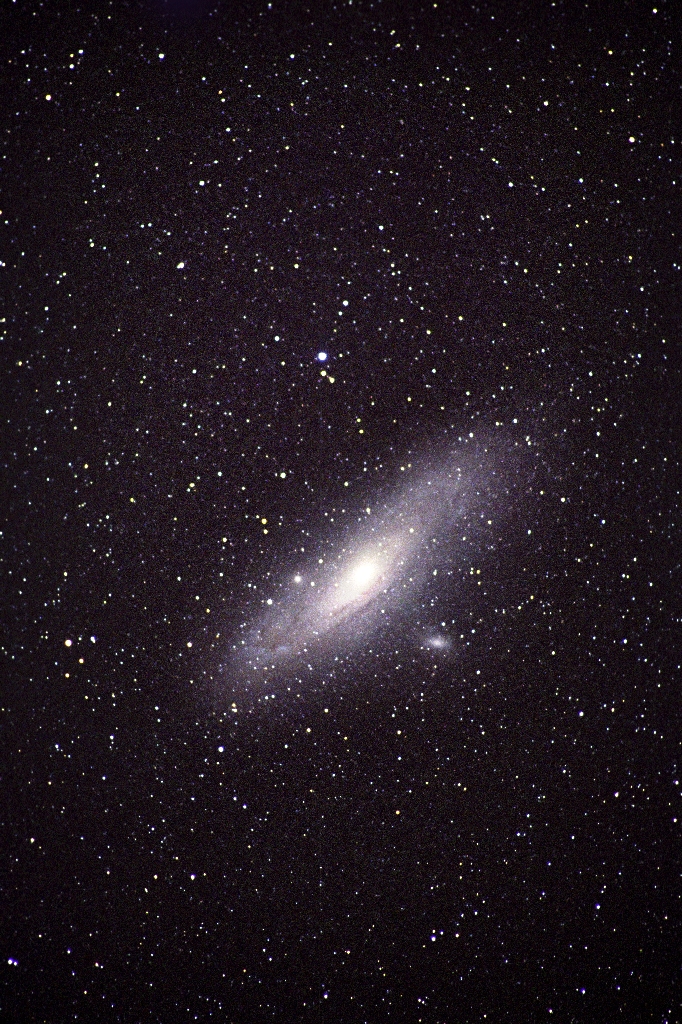
The Andromeda galaxy

One chance. Once chance to get it right, with sooo many things that could go wrong! 

Almost ten years ago I could use for a night a telescope on an equatorial mount to piggyback my Canon T70 with a 200mm f/4 lens and ISO 400 film :D 

One of the targets was of course M31, the Andromeda Galaxy. It was a lot of fun, as one could not see what he's doing and manually guiding 30 minutes it's not an easy task: the slightest mistake could and would of ruined the picture.

But I kept my hand steady, my eye sharp and prayed to the control towers to divert planes from my field of view:

   Take a good look at it as we're going to crash with this giant galaxy in no time (~4 billion years!).  

Milky Way over Las Campanas

The center of our galaxy rises over the Las Campanas Observatory, with the twin 6.5m Magellan telescopes visible at the bottom of the image. It's not too far from the Cerro Tololo Inter-American Observatory and if you're around there, visit them both!


From the eye of the lama to the little horse, it's all there.

Thursday, June 21, 2012

Cosmic dance and elegance

In their way through space, galaxies usually meet and interact, creating new structures. Thirty years ago a Canadian astronomer (Paul Hickson) created a catalogue of 462 such closely interacting systems, most often composed of 4-5 galaxies as closely packed together as the galaxies in the center of  some clusters of galaxies. We don't know precisely yet how many of  the galaxies in these systems are interacting and how many are just chance alignments, but studies have shown that for about half there is some physical connection involved. 

A theory suggests that these systems are on their way of creating an elliptical galaxy, so stay tuned! 


   Below, the cosmic dance brought together in HCG 44 three spirals and a small elliptical galaxy, NGC 3190, NGC 3193, NGC 3185 and NGC 3187 and signs of their interactions abound (tidal tails, disc distortions...)


Meanwhile in Pegasus, ~40 million light years away, edge-on spiral galaxy NGC 7814 elegantly displays her slightly warped edge-on disc. It is also called Little Sombrero after her closer and larger brother M 104. There are many faint galaxies seen around it and as their light passed through the halo of the galaxy is gets a little redder.


      Elegant, isn't it?


All images taken through the 0.5m Argelander Institute for Astronomy Institute in Bonn.

Sunday, May 27, 2012

M 109

Similar to our galaxy in size and shape (it's a barred spiral galaxy), our sister lies 83 million light years away towards the Ursa Major constellation.

When I first saw it nine years ago as a faint patch of light near the bright star Phecda, I imagined exactly this: 

Tuesday, March 20, 2012

M 95 supernova

...and we have another bright supernova! Colloquially called PSN J10435372+1140177, this time it is in M 95, a barred - spiral - ring galaxy in Leo and it's brightening fast. We don't know yet what kind of supernova is it, but more observations will let us know soon :)

Let's also wait for the IAU to officially annnounce it, it has been discovered or a few days already by the Italian Supernovae Search Project.

Images taken together with Dominik Klaes, Daniel Lenz and Katharina Sendlinger.

Tuesday, February 28, 2012

ORM (I)

Observatorio del Roque de los Muchachos

El Teide from La Palma


Cherenkov realm


Up


"Band picture": the team!


INT
Marcel, Oana, Ovidiu, Alex, Alin, Dana, Toma


MAGIC is magic


DOT (.) - Dutch Open Telescope, ofcourse


The road to Sgr A


MAGIC and FACT