Showing posts with label Argelander Institute for Astronomy. Show all posts

Tuesday, January 28, 2014

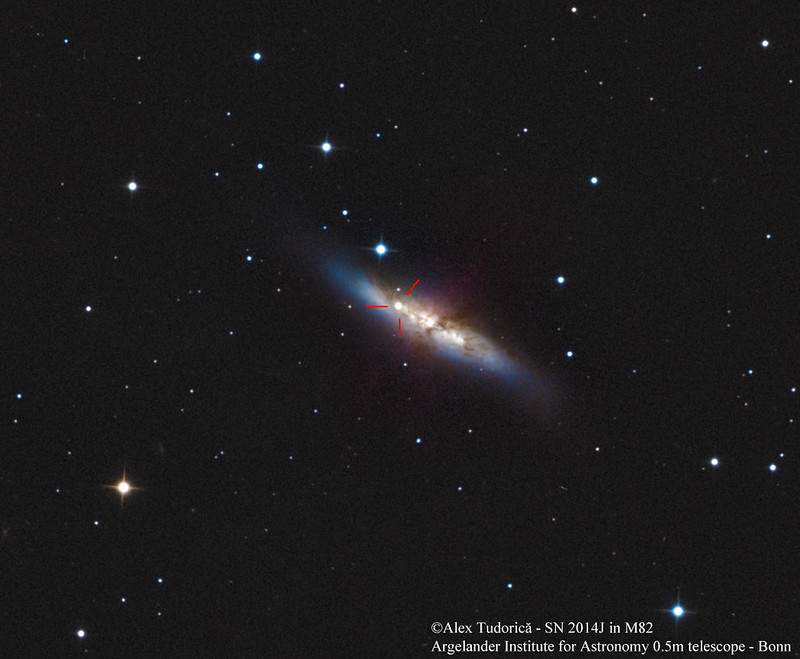
SN 2014J

Supernova in M82: SN 2014J It's a quite important supernova, as it could shed light on some issues that these cosmic standard candles have. Too bad it has a lot of dust reddening, which complicates matters a lot.

    Having a look a the AAVSO light curves, I'd say that it won't be brighter than 9.5m at maximum, but let's see!

    Here's the image taken with our 0.5m rooftop telescope in Bonn, at the Argelander Institute for Astronomy:


Technical details here: http://www.flickr.com/photos/27891676@N05/12165418933/

Friday, March 15, 2013

One night of video meteors

    I was mentioning in my previous post that I've also used my video camera during the observations night. 

   A total of 10 meteors were detected, a quite good catch I might add, as the ZHR for a visual observer in the best conditions is only about 2 around this date. From the center of one of the most populated areas in Europe I could detect the same numbers of meteors as a visual observer with perfect conditions at hand, with much higher positional and luminosity accuracy, plus no frozen fingers. 

   I'm impressed and I can't wait to see a Perseid maximum with this kind of setup :) And hopefully with a nice double station setup back at home, in Romania. A little bit of science awaits!

  A short video with these first few meteors; just make sure to spot them all as some are quite faint and fast!

Cassegrain prime focus test

Yesterday I have received and email that looked very interesting: apparently we had anything in place to use our 50 cm Cassegrain also in prime focus. Looking at the weather I had no hope of seeing the CCD camera in prime focus operation anytime soon, but after I saw the comet (which was also hopeless just a few hours before), I stayed at the institute so test the setup.

It's rather easy: one has to remove the secondary mirror from its place and then uncover the corrector lens, fixing the camera into its place. The only problem is that the power cables were too short, but there's really nothing that some duct tape won't fix :D

As soon as I was reaching focus, David Muelheims join me for observations; we did not plan at the time to stay until 7 am the second day!

When we first saw our focusing frames our jaws dropped: the level of intricate detail with an exposure time of 1s was absolutely brilliant!! (we used M42 as a target for focusing)

Our next target was the Horsehead - Flame nebulae area. Unfortunately, as they were already quite low when we started, there was not much time to make a nice color image, so only about 60 minutes of H-alpha data are stacked below. After fiddling a bit with it I got this: 

Can't wait to get a proper color version of it!...

We then took some images for Cone nebula (I'll show that when it's nice and in colour) and we switched to the Leo triplet: M65, M 66 and NGC 3628. With the camera mounted in the Cassegrain focus, to get such an image would of  taken more than 110 hours!! This is the result of only 4 hours of data acquisition plus about two for post processing:


Processing the Leo Triplet image was a nightmare because it's very difficult to get good calibration frames with this telescope; the flats match the images badly. One can only get rid of this by exposing and dithering a lot more than we did. Maybe also observing in only one filter per night might help, I have the impression that the filters don't go back precisely the way they were before changing to some other one. 


   Besides all of this, I've made also some video meteor observations, but about that in another post :)


All images in this post have been taken jointly by me and David; data processing was only my task.

Comet PAN-STARRS (C/2012 L4)

  Finally, after 8 failed attempts to detect this comet, the ninth one brought luck with it!  I've tried during daylight, during sunset, during twilight and always that pesky cloud sat over it. But no more :)

    Initially I thought I lost it, but I was pushing my fingers just a little bit more (it was around -3C and windy), maybe I get lucky. Almost one hour of hunting through clouds later, I saw it! What a great moment! It was definitely much brighter than I expected it to be.


    Here are some pictures and a time lapse video, which is too short because not only my fingers were affected by the cold, unfortunately.... But I promise to have something of higher quality as soon as the weather gets better (which might be never, after all this winter was the cloudiest in 60 German years...)


     .... and the short time lapse can be seen below... 


Monday, February 18, 2013

Asteroid 2012 DA14

Asteroid 2012 DA14 just set the record for the closest known approach to Earth of an object of its size. It also passed by Bonn and I had a chance of seeing it after the clouds cleared.

However, some clouds still went by, as you can see in the video below.


As usually, the frames were taken with the Argelander Institute for Astronomy 0.5m rooftop telescope, from the center of one of the most densely populated regions in Europe (with the unfortunate side effect that the light pollution is absolutely terrible).

Comet C/2012 S1 (ISON) (III)

My first color image of the awesome comet ISON. It's not very pleasing aesthetically, but it will get better with time. Check out the other two posts about it, I and II for more info, pictures and animations!


   The images were taken last night, on the 17/18th of February 2013, with the 0.5m Argelander Institute for Astronomy roof telescope, from one of the most inhabited regions of Europe, with the corresponding light pollution. 

Monday, February 11, 2013

Comet C/2012 S1 (ISON) (II)

Comet ISON is due to become one of the greatest comets to grace our skies during the last few hundreds of years. Possibly. Hopefully. Comets are unpredictable. 

In a previous post I took a few pictures of the comet while it was very, very faint and far away. Only a couple of months later it is much brighter, at magnitude 16.7 V and is getting brighter by the moment. I'd like to follow this comet in its journey through the solar system. 


It we add the images after we aligned them by the stars, the comet looks like a fuzzy streak: it is moving and it is not pointlike any more. 


If we add the images by centering all of them on the comet, we'll have star trails and a nice, little comet that already has a tail and coma. 


And finally, if we just center ll the images on the comet and then make a short movie out of them, we get this: 


    More to come as the German skies will get clearer in the spring :)

Thursday, February 7, 2013

ELAIS-N2-P2

As promised, a few crops from the second 1x1 degree mosaic image, composed from u, g, r and z-band data in the SpARCS ELAIS-N2-P2 field (as B, V, R and violet channels). Total exposure time is about 3h, with the MEGAPRIME camera installed on the 3.6m Canada-France Hawaii Telescope. The second field was much more interesting than the first one. 

The original image is about 6.4 Gb, so I had to crop some more interesting regions. 


Great pair of galaxies


Galaxt mixing at it's best

Wednesday, May 2, 2012

Crab nebula and polarized light

      Besides wavelength (color), photons have other properties too: if seen as a wave their electric field oscillates in a plane which can remain fixed or rotate in time and by convention we describe this polarization state by specifying the orientation of the electric field over one oscillation.

      Polarimetry is a very useful tool for determining what kind of physical processes are at work in the light source (especially for synchrotron radiation) and the distribution of magnetic fields in it: there is much more to light than just color!

     Polarimetry color information superimposed on a "normal" photograph of Crab nebula creates the unusual picture below. The red color in the nebula comes from an arbitrary initial polarisation angle (we weren't able to find out yet the true polarizing angle), the green shows 45 degrees more and the blue is with the filter rotated by 90 degrees compared to the original position.


The image has been made by me (color and luminance data) and David Muelheims (polarized data), in Bonn, Germany.

        And although "popular wisdom" might tell you that the human eye cannot distinguish between polarization states, it's not really true, as Haidinger found out many, many years ago :)

Tuesday, March 20, 2012

M 95 supernova

...and we have another bright supernova! Colloquially called PSN J10435372+1140177, this time it is in M 95, a barred - spiral - ring galaxy in Leo and it's brightening fast. We don't know yet what kind of supernova is it, but more observations will let us know soon :)

Let's also wait for the IAU to officially annnounce it, it has been discovered or a few days already by the Italian Supernovae Search Project.

Images taken together with Dominik Klaes, Daniel Lenz and Katharina Sendlinger.