Showing posts with label AIfA. Show all posts

Tuesday, January 28, 2014

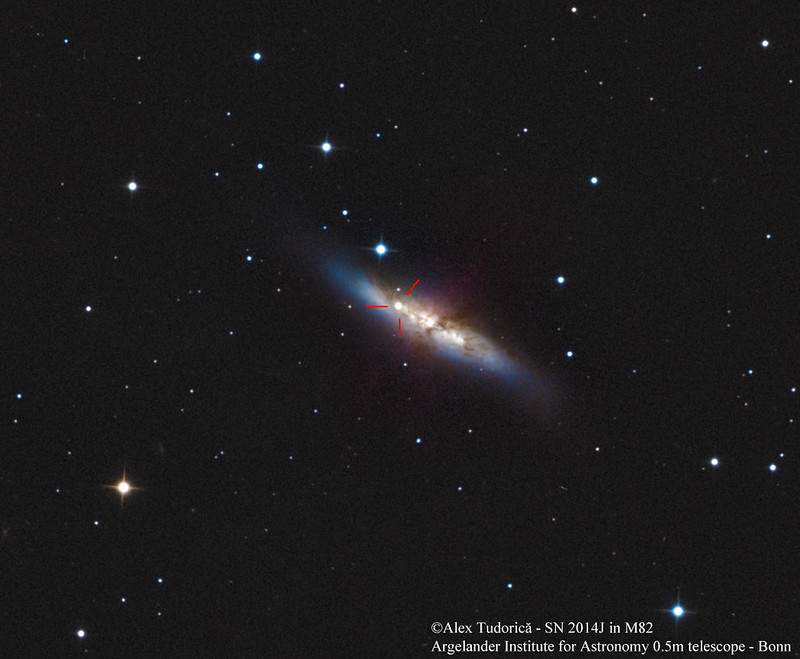
SN 2014J

Supernova in M82: SN 2014J It's a quite important supernova, as it could shed light on some issues that these cosmic standard candles have. Too bad it has a lot of dust reddening, which complicates matters a lot.

    Having a look a the AAVSO light curves, I'd say that it won't be brighter than 9.5m at maximum, but let's see!

    Here's the image taken with our 0.5m rooftop telescope in Bonn, at the Argelander Institute for Astronomy:


Technical details here: http://www.flickr.com/photos/27891676@N05/12165418933/

Tuesday, October 22, 2013

The Tadpole galaxy

In most of my fields for the PhD project I'm currently most involved in, there are lots of weird and interesting objects, most of them probably unknown, at least to the general public. However, from time to time I stumble upon gems such as the 400 million light years distant Tadpole galaxy:


Check out a high quality version on my Flickr account.

Tuesday, September 10, 2013

M33 revisited


About one year ago we discovered that our 0.5m Cassegrain rooftop telescope can be used in prime focus mode, but until now I had little time to revisit a wonderful galaxy, M33. 
   There are many star forming regions visible in the Hydrogen alpha image (red in the image below), king of all being NGC 604, a nebula far larger than our familiar Orion Nebula. 

Prime focus, 4 nights of imaging, RVBHa, about 2.5h per filter.


And the old, Cassegrain focus version, about 12h of exposure time in total, LRVBHa:

Comet ISON (IV)


Comet ISON (C/2012 S1) is back, but not with a bang. It looks like the comet could not keep up the brightening rate and now the predictions for the maximum luminosity have dropped quite a lot (check out Seiichi Yoshida's awesome graphs and information about comet ISON). It can still surprise us, especially as it will pass so close to the Sun, but for the moment the hopes are not that high any more. 

The comet was still in twilight when I photographed it for the first time after passing through the conjunction with the Sun. Images taken on the 3rd and 5th of September. 
Image taken with the 50 cm telescope on top of the Argelander Institute for Astronomy. 

SN 2013EV

A very faint supernova in a galaxy that we've all seen so many times: IC 1296. Not a very impressive galaxy, but got it's fame for being very close (4 arcminutes) to a night sky celebrity: M 57, the Ring Nebula. While IC 1296 lies at a distance of about 221 million light years, the nearby Ring is only 2300 light years away.

   An image I took about a week ago:

Larger versions on Flickr.

Saturday, June 1, 2013

Thursday, May 16, 2013

CFHTLS Ultra Deep Fields: D1

Sometimes, my PhD carries me to galaxies far, far away. The CFHTLS Deep Fields were processed in PixInsight and below you can see only a few small cuts from only one of these fields. Full resolution versions of the complete four fields will come soon! ;) 

The images are made from the i g r band transposed into R B V channels, amounting to about 50h total exposure time on a 4m class telescope, with a median seeing of..... only 0.55"!!


But I should allow the Universe speak it's own beauty: 


Friday, March 1, 2013

Moon: close-up

This is my first attempt at taking high resolution images of some celestial object, in this case it was the Moon.  From about 1700 frames, the best 30% were stacked in Registax 6.0 to produce a "high resolution" image of a few craters. The smallest resolved detail is about 3 km large, all this with a rather horrible seeing of 3". I basically had no idea what I was doing with the wavelet filters, they always introduced some very unnatural plastic look for my taste, so I only used them to some moderate effect. 

Unfortunately, although the telescope I'm using is quite large for this kind of stuff (0.5m, f/9), the fact that it lies on the roof of a heated building means that my seeing will very rarely be better than 3" :( But I'll try more, who knows, I might get lucky one day! I'm using a Canon 600D to take the movies, which has the unfortunate side-effect that I have to transform the original MOV files to AVI, therefore loosing a bit more information in the process... 


   I have a couple more movies taken that night awaiting processing, so soon there should be an update to this post :)

------------------------------------------------------------------------------------------------------------
Update: 02 March 2013
------------------------------------------------------------------------------------------------------------

Two more images came through the processing pipeline, showing the immediate area around the close-up above and another, northern region:


Monday, February 18, 2013

Asteroid 2012 DA14

Asteroid 2012 DA14 just set the record for the closest known approach to Earth of an object of its size. It also passed by Bonn and I had a chance of seeing it after the clouds cleared.

However, some clouds still went by, as you can see in the video below.


As usually, the frames were taken with the Argelander Institute for Astronomy 0.5m rooftop telescope, from the center of one of the most densely populated regions in Europe (with the unfortunate side effect that the light pollution is absolutely terrible).

Comet C/2012 S1 (ISON) (III)

My first color image of the awesome comet ISON. It's not very pleasing aesthetically, but it will get better with time. Check out the other two posts about it, I and II for more info, pictures and animations!


   The images were taken last night, on the 17/18th of February 2013, with the 0.5m Argelander Institute for Astronomy roof telescope, from one of the most inhabited regions of Europe, with the corresponding light pollution. 

Thursday, February 7, 2013

ELAIS-N2-P2

As promised, a few crops from the second 1x1 degree mosaic image, composed from u, g, r and z-band data in the SpARCS ELAIS-N2-P2 field (as B, V, R and violet channels). Total exposure time is about 3h, with the MEGAPRIME camera installed on the 3.6m Canada-France Hawaii Telescope. The second field was much more interesting than the first one. 

The original image is about 6.4 Gb, so I had to crop some more interesting regions. 


Great pair of galaxies


Galaxt mixing at it's best

Wednesday, February 6, 2013

ELAIS-N2-P1

A few crops from a 1x1 degree mosaic image, composed from g, r and z-band data in the SpARCS ELAIS-N2-P1 field (as B, V and R channels). Total exposure time is about 3h, with the MEGAPRIME camera installed on the 3.6m Canada-France Hawaii Telescope

The original image is 4.7 Gb, so I had to crop some more interesting regions. 

Nicely disturbed galaxy


 Galaxy string


Hundreds of galaxies in just a few arcminutes


The power of a 4m class telescope is still great! :) More images to come soon, as I see interesting regions in the data I have. 


Wednesday, May 2, 2012

Crab nebula and polarized light

      Besides wavelength (color), photons have other properties too: if seen as a wave their electric field oscillates in a plane which can remain fixed or rotate in time and by convention we describe this polarization state by specifying the orientation of the electric field over one oscillation.

      Polarimetry is a very useful tool for determining what kind of physical processes are at work in the light source (especially for synchrotron radiation) and the distribution of magnetic fields in it: there is much more to light than just color!

     Polarimetry color information superimposed on a "normal" photograph of Crab nebula creates the unusual picture below. The red color in the nebula comes from an arbitrary initial polarisation angle (we weren't able to find out yet the true polarizing angle), the green shows 45 degrees more and the blue is with the filter rotated by 90 degrees compared to the original position.


The image has been made by me (color and luminance data) and David Muelheims (polarized data), in Bonn, Germany.

        And although "popular wisdom" might tell you that the human eye cannot distinguish between polarization states, it's not really true, as Haidinger found out many, many years ago :)

Tuesday, March 20, 2012

M 95 supernova

...and we have another bright supernova! Colloquially called PSN J10435372+1140177, this time it is in M 95, a barred - spiral - ring galaxy in Leo and it's brightening fast. We don't know yet what kind of supernova is it, but more observations will let us know soon :)

Let's also wait for the IAU to officially annnounce it, it has been discovered or a few days already by the Italian Supernovae Search Project.

Images taken together with Dominik Klaes, Daniel Lenz and Katharina Sendlinger.