Showing posts with label astronomy. Show all posts

Tuesday, May 6, 2014

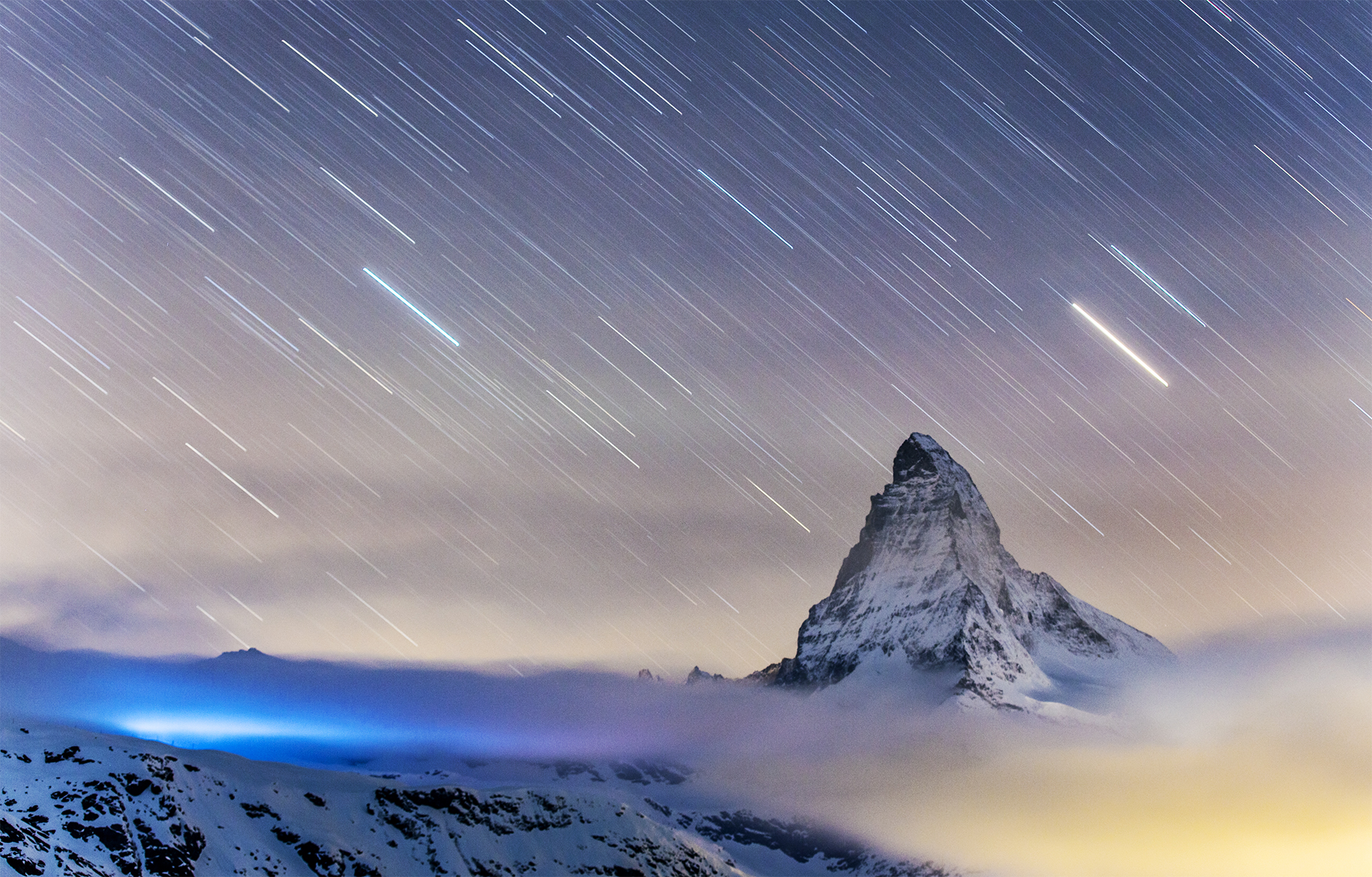
Matterhorn at night

I've been traveling a lot lately to Switzerland, twice getting really close to the Matterhorn after our dear star was hidden from sight by the edge of the Earth. Enjoying the cold, I took a few pictures, out of which I like this one best. 

Thursday, October 24, 2013

Startrails in the Canaries

A few months ago I decided to look through my images from the Canary islands that I took during the past couple of years and make a few star trails out of them. Below are the selected four: 

The western view from the INT 2.5m telescope terrace. Moon, Venus and Jupiter are the three brightest streaks in the image. An observer's car illuminates the road in red. 


Mount Teide reigns in the left part of the image, while Venus and Jupiter set in the early twilight. For the cities below, the night has already arrived and the street lights illuminate the clouds from below. 

Back to the island of La Palma, the MAGIC telescopes scan the skies for Cherenkov light cones, while the Moon high in the sky illuminates the landscape. 

The final set of trails comes from near the top of the Teide Volcano in Tenerife. I love how the road is visible due to the (very few) passing cars and how a little bolide (at least -5m!) decided to show up near the lower right of the image. 

Tuesday, September 10, 2013

Comet ISON (IV)


Comet ISON (C/2012 S1) is back, but not with a bang. It looks like the comet could not keep up the brightening rate and now the predictions for the maximum luminosity have dropped quite a lot (check out Seiichi Yoshida's awesome graphs and information about comet ISON). It can still surprise us, especially as it will pass so close to the Sun, but for the moment the hopes are not that high any more. 

The comet was still in twilight when I photographed it for the first time after passing through the conjunction with the Sun. Images taken on the 3rd and 5th of September. 
Image taken with the 50 cm telescope on top of the Argelander Institute for Astronomy. 

Saturday, June 1, 2013

Friday, March 15, 2013

Cassegrain prime focus test

Yesterday I have received and email that looked very interesting: apparently we had anything in place to use our 50 cm Cassegrain also in prime focus. Looking at the weather I had no hope of seeing the CCD camera in prime focus operation anytime soon, but after I saw the comet (which was also hopeless just a few hours before), I stayed at the institute so test the setup.

It's rather easy: one has to remove the secondary mirror from its place and then uncover the corrector lens, fixing the camera into its place. The only problem is that the power cables were too short, but there's really nothing that some duct tape won't fix :D

As soon as I was reaching focus, David Muelheims join me for observations; we did not plan at the time to stay until 7 am the second day!

When we first saw our focusing frames our jaws dropped: the level of intricate detail with an exposure time of 1s was absolutely brilliant!! (we used M42 as a target for focusing)

Our next target was the Horsehead - Flame nebulae area. Unfortunately, as they were already quite low when we started, there was not much time to make a nice color image, so only about 60 minutes of H-alpha data are stacked below. After fiddling a bit with it I got this: 

Can't wait to get a proper color version of it!...

We then took some images for Cone nebula (I'll show that when it's nice and in colour) and we switched to the Leo triplet: M65, M 66 and NGC 3628. With the camera mounted in the Cassegrain focus, to get such an image would of  taken more than 110 hours!! This is the result of only 4 hours of data acquisition plus about two for post processing:


Processing the Leo Triplet image was a nightmare because it's very difficult to get good calibration frames with this telescope; the flats match the images badly. One can only get rid of this by exposing and dithering a lot more than we did. Maybe also observing in only one filter per night might help, I have the impression that the filters don't go back precisely the way they were before changing to some other one. 


   Besides all of this, I've made also some video meteor observations, but about that in another post :)


All images in this post have been taken jointly by me and David; data processing was only my task.

Comet PAN-STARRS (C/2012 L4)

  Finally, after 8 failed attempts to detect this comet, the ninth one brought luck with it!  I've tried during daylight, during sunset, during twilight and always that pesky cloud sat over it. But no more :)

    Initially I thought I lost it, but I was pushing my fingers just a little bit more (it was around -3C and windy), maybe I get lucky. Almost one hour of hunting through clouds later, I saw it! What a great moment! It was definitely much brighter than I expected it to be.


    Here are some pictures and a time lapse video, which is too short because not only my fingers were affected by the cold, unfortunately.... But I promise to have something of higher quality as soon as the weather gets better (which might be never, after all this winter was the cloudiest in 60 German years...)


     .... and the short time lapse can be seen below... 


Friday, March 1, 2013

Moon: close-up

This is my first attempt at taking high resolution images of some celestial object, in this case it was the Moon.  From about 1700 frames, the best 30% were stacked in Registax 6.0 to produce a "high resolution" image of a few craters. The smallest resolved detail is about 3 km large, all this with a rather horrible seeing of 3". I basically had no idea what I was doing with the wavelet filters, they always introduced some very unnatural plastic look for my taste, so I only used them to some moderate effect. 

Unfortunately, although the telescope I'm using is quite large for this kind of stuff (0.5m, f/9), the fact that it lies on the roof of a heated building means that my seeing will very rarely be better than 3" :( But I'll try more, who knows, I might get lucky one day! I'm using a Canon 600D to take the movies, which has the unfortunate side-effect that I have to transform the original MOV files to AVI, therefore loosing a bit more information in the process... 


   I have a couple more movies taken that night awaiting processing, so soon there should be an update to this post :)

------------------------------------------------------------------------------------------------------------
Update: 02 March 2013
------------------------------------------------------------------------------------------------------------

Two more images came through the processing pipeline, showing the immediate area around the close-up above and another, northern region:


Monday, February 18, 2013

Asteroid 2012 DA14

Asteroid 2012 DA14 just set the record for the closest known approach to Earth of an object of its size. It also passed by Bonn and I had a chance of seeing it after the clouds cleared.

However, some clouds still went by, as you can see in the video below.


As usually, the frames were taken with the Argelander Institute for Astronomy 0.5m rooftop telescope, from the center of one of the most densely populated regions in Europe (with the unfortunate side effect that the light pollution is absolutely terrible).

Comet C/2012 S1 (ISON) (III)

My first color image of the awesome comet ISON. It's not very pleasing aesthetically, but it will get better with time. Check out the other two posts about it, I and II for more info, pictures and animations!


   The images were taken last night, on the 17/18th of February 2013, with the 0.5m Argelander Institute for Astronomy roof telescope, from one of the most inhabited regions of Europe, with the corresponding light pollution. 

Monday, February 11, 2013

Comet C/2012 S1 (ISON) (II)

Comet ISON is due to become one of the greatest comets to grace our skies during the last few hundreds of years. Possibly. Hopefully. Comets are unpredictable. 

In a previous post I took a few pictures of the comet while it was very, very faint and far away. Only a couple of months later it is much brighter, at magnitude 16.7 V and is getting brighter by the moment. I'd like to follow this comet in its journey through the solar system. 


It we add the images after we aligned them by the stars, the comet looks like a fuzzy streak: it is moving and it is not pointlike any more. 


If we add the images by centering all of them on the comet, we'll have star trails and a nice, little comet that already has a tail and coma. 


And finally, if we just center ll the images on the comet and then make a short movie out of them, we get this: 


    More to come as the German skies will get clearer in the spring :)

Thursday, February 7, 2013

ELAIS-N2-P2

As promised, a few crops from the second 1x1 degree mosaic image, composed from u, g, r and z-band data in the SpARCS ELAIS-N2-P2 field (as B, V, R and violet channels). Total exposure time is about 3h, with the MEGAPRIME camera installed on the 3.6m Canada-France Hawaii Telescope. The second field was much more interesting than the first one. 

The original image is about 6.4 Gb, so I had to crop some more interesting regions. 


Great pair of galaxies


Galaxt mixing at it's best

Monday, November 12, 2012

The bolides of Teide


       After ascending to 3100m to Tenerife's Pico Viejo on last Saturday (10th of November) and descending at night, the whole party of five was quite tired (after all, the sign at the beginning of the path was marked with the "Extreme difficulty" distinction). We laughed in the face of danger. Although the initial plan was to spend the night under the stars together, the others gave in to thirst, hunger and tiredness but I could only ask them to leave me closer to the Teide Observatory: it was a night close the Taurid meteor shower maximum and some bright meteors were promised. At least for my effort I should of been a bit rewarded.

     So, they brought me to within 1 km of the observatory and packed me with blankets, warm clothes and the rest of the food and water, leaving me alone in starlight. Fortunately, Etienne was a great guy and promised to pick me up in the morning, otherwise I was supposed to walk about 10 km or so to the main road and take the bus at 16:00 back to Puerto de la Cruz. And he did, so I got a lot more sleep on Sunday :)

I was initially planning to take a long time-lapse, until dawn, but when I went to check the camera after some time I realized that some clouds/fog (basically the same thing there) passed by and ruined the whole idea. Scanning quickly through the images revealed though that the fireball (bolide) I barely saw some time earlier was indeed in one of the images. Oh, joy!! It is probably the brightest meteor I have ever photographed and I used for that a 8mm fisheye lens at 5.6, ISO 1600 on a Canon 600d and 45s exposure time. 


The winter Milky Way rises, meteors fall


     Today I played a bit with the lightcurve and reached the graph below. I took a 58x670 pixels crop of both the meteor and Castor and Pollux, plotting on the X axis the pixel number and on the Y axis the values in counts of all the 58 pixels of the line perpendicular to the meteor trajectory and the Castor-Pollux line. 

Then I averaged the values of the three CCD channels (RGB) and multiplied the result with 256, for convenience. The red shows the meteor lightcurve and the black the spatial lightcurve of the two standard stars used, Castor and Pollux.

 After performing a little statistical analysis of the values I equalized the backgrounds of the meteor image and of the standard stars to have the same zeropoint and therefore a meaningful comparison. Calculating the FWHM of the stars in pixels which allowed the transformation to arcminutes, using the pixel scale of the camera-lens combination.

 Assuming an angular velocity of 15 degrees per second for the meteor, it is then possible to calculate the time the meteor took to cross 3 arcminutes.  As the flux ratios of Castor and the maximum brightness of the meteor seem about the same, the ratios of the exposure times/3arcminutes should give us the flux ratios.

 The meaning of the values cited in the figure are: V is the pre-atmospheric velocity (km/s), the elevation h_b (degrees), the altitude H_b (km) of its start point, and the angular distance between its end point and the radiant D (degrees). 

As I mentioned I barely was it and it seemed quite (angularly) fast to me, so an Andromedid label is excluded and the Taurid origin is out of the question also from the track orientation, at least at first sight.


And that's how I got an approximate magnitude of -8.5m for this fireball :)


There were other meteors and this is the second (and last) bolide I captured on camera that night. The analysis above cannot be performed though, as the meteor track is saturated and only a minimum magnitude can be obtained in that way. 


Venus and the Moon joined the show :)


 A 100% crop of the meteor captured above. It's kind of wiggly and I wonder if it's a sampling effect or a true physical effect. 
Wednesday, October 24, 2012

Comet C/2012 S1 (ISON) & Co


The comet season is here!


After the great comet of 2007, comet McNaught and the great comet of 2011, comet Lovejoy, we might be due to another Great One. Comet C/2012 S1 (ISON) was discovered on the 21st of September 2012 by Vitali Nevski and Artyom Novichonok, working with the International Scientific Optical Network (ISON). The preliminary orbit predicts that the comet will pass 1.8 million kilometers away from the Suns center and 1.1 million kilometers above it's surface on the 28th of November 2013.


This very close approach will melt and vaporize parts of the comet and it might develop a spectacular tail, with the potential of being much brighter that the Full Moon (some predictions reach magnitude -16). It is also well placed for observations from the Nothern Hemisphere, unlike the previous two great comets of this century. But let's not forget comet Kohoutek, which was another bright hope that ended in darkness: comets are notoriously unpredictable. 

Just one more interesting "coincidence". The orbit of comet C/2012 S1 looks quite similar to that of the Great Comet of 1680. It might be that they had the same parent body, which fragmented a long time ago. Hopefully we'll have the fun Newton had while he observed it. 


Right now it is beyond the orbit of Jupiter and looks like a very faint smudge at magnitude 17.5 V, but mark your calendars for late 2013 as you might be in for the show of a lifetime!

I observed this comet last night, with the 0.5m Argelander Institute telescope (as usually).


But there are other icy snowballs visiting the inner solar system :) 


One of them is comet C/2010 S1 (LINEAR), now shining at magnitude 13.3. It brighten to magnitude 13 or so in mid-2013 an then it will slowly fade away. A much more discreet visitor than comet ISON!

The second one is Comet C/2012 K5 (LINEAR), which will brighten to magnitude 8 in late December 2012 - early January 2013.  Right now it is at magnitude 11.1. Northern observers will have the best view, as it will silently slide from Ursa Major to Taurus in this time. As the comet was moving rather fast, I had to stack the images by centering all of them on the comet: that is the reason for which the stars look like trails while the comet looks just fine :) There was a gap in the observations and that's why the star trails come in pairs.
These last two comets were observed on the 24th of June 2012.

UPDATE: 13 January 2013
========================================================================
Thcomet C/2012 K5 (LINEAR) has indeed brightened up to magnitude 8 during the last few months. An animation of the comet sliding among the stars can be seen below. The magnitude of the nucleus only as reported by Astrometrica is 14.8 V. 


Sunday, October 21, 2012

Wavy Perseid trail


Meteors are the blazing trails that smaller than one would expect dust leave while entering our atmosphere at huge velocities (from about 20 to 70 kilometers per second). A millimeter sized particle would produce a very bright meteor, probably not unlike the -8m one that left the trail pictured below. Sometimes these ionized gases remain visible for so long that high atmosphere winds distort them in funny ways:

The picture was taken in August 2008 during the maximum of the Perseid meteor shower from the top of the Omu Peak in the Romanian Carpathians.

Friday, August 3, 2012

Milky Way over Las Campanas

The center of our galaxy rises over the Las Campanas Observatory, with the twin 6.5m Magellan telescopes visible at the bottom of the image. It's not too far from the Cerro Tololo Inter-American Observatory and if you're around there, visit them both!


From the eye of the lama to the little horse, it's all there.

Monday, June 25, 2012

Winter cone

  The famous Cone Nebula can be found in the constellation of Monoceros and it's one of those star forming factories in our galaxy which already created a very young star cluster (the Christmas tree, NGC 2264 :) ). S Monocerotis is responsible lighting up the last remains of the "mother - gas cloud". 7 light years across (10 arcminutes) and 2700 light years distant, the Cone Nebula is part of a huge star forming complex in the winter skies, a blend of dark and excited gas and dust clouds.


 I have always wished for a Christmas Tree like this. 


Thursday, June 21, 2012

Cosmic dance and elegance

In their way through space, galaxies usually meet and interact, creating new structures. Thirty years ago a Canadian astronomer (Paul Hickson) created a catalogue of 462 such closely interacting systems, most often composed of 4-5 galaxies as closely packed together as the galaxies in the center of  some clusters of galaxies. We don't know precisely yet how many of  the galaxies in these systems are interacting and how many are just chance alignments, but studies have shown that for about half there is some physical connection involved. 

A theory suggests that these systems are on their way of creating an elliptical galaxy, so stay tuned! 


   Below, the cosmic dance brought together in HCG 44 three spirals and a small elliptical galaxy, NGC 3190, NGC 3193, NGC 3185 and NGC 3187 and signs of their interactions abound (tidal tails, disc distortions...)


Meanwhile in Pegasus, ~40 million light years away, edge-on spiral galaxy NGC 7814 elegantly displays her slightly warped edge-on disc. It is also called Little Sombrero after her closer and larger brother M 104. There are many faint galaxies seen around it and as their light passed through the halo of the galaxy is gets a little redder.


      Elegant, isn't it?


All images taken through the 0.5m Argelander Institute for Astronomy Institute in Bonn.

Sunday, May 27, 2012

M 109

Similar to our galaxy in size and shape (it's a barred spiral galaxy), our sister lies 83 million light years away towards the Ursa Major constellation.

When I first saw it nine years ago as a faint patch of light near the bright star Phecda, I imagined exactly this: 

Monday, May 21, 2012

Peak District: cold, night, spring


Twilight arrives finally in UK's Peak District National Park. Charged with color beauty, Venus trails along the Pleiades on it's journey away from the Sun: it is the last time it goes away from it before the famous Venus transit this June (more about that soon!).

  Even though it's cold, some people do look up, through the dense photon cloud of light pollution

The road to light below us (it was oriented towards West :) )


        ... and he stands below all that is timeless for most humans: stars!

Friday, May 4, 2012

Celestial highway

Planets wander on the sky on their own highway: the zodiacal band. Even dust in the solar system is somewhat confined to this plane and you can see it here as a lighter conical region in the middle of the image. Sometimes the planets and the Moon catch up in meetings as beautiful as this one:

Moon-Venus-Jupiter conjunction

Sitting on the caldera edge of the Taburiente supervolcano in the Atlantic ocean, a true photon feast!